What Are the 5 Stages of Child Development?

A Complete Toddles Toodles Parent Guide
stages-of-child-development

Child development isn’t a race—it’s a beautiful journey filled with discovery, curiosity, connection, and growth. At Toddles Toodles, our approach blends the IB PYP’s inquiry-driven philosophy with Reggio, Waldorf, and HighScope principles to support children at every stage of development.

Parents often ask:

  • What are the 5 stages of child development?
  • What should my child be doing at each stage?
  • How can I support them at home?

Introduction: Understanding Growth in the Early Years

The early years lay the foundation for life. Research shows that the first five years influence emotional security, cognitive development, social behaviour, language, and lifelong learning.

At Toddles Toodles, we view development as a holistic process that unfolds through:

  • Play
  • Nurturing relationships
  • Exploration
  • Inquiry
  • Predictable routines
  • Creativity and imagination
  • A prepared environment that acts as the “third teacher.”

Understanding child development stages helps parents respond with confidence and create supportive environments both at home and in school.

Introduction: Understanding Growth in the Early Years

1. Newborn Stage (Birth to 2 Months)

Newborns learn through their senses—warmth, touch, voice, smell, and gentle motion. At this age, connection is the curriculum.

Key Milestones

  • Recognising familiar voices
  • Strong reflexes (rooting, grasping, sucking)
  • Beginning to track faces and movement
  • Responding to comfort, rocking, and soft sound

How Parents Can Support

  • Talk and sing softly
  • Offer skin-to-skin bonding
  • Respond consistently to cues
  • Build calm feeding and sleep routines

Newborn growth is about trust and emotional grounding—everything else builds from here.

2. Infant Stage (2 Months to 12 Months)

Infants become little explorers. They begin to understand cause-and-effect, interact socially, and build foundational motor and language skills.

Key Milestones

  • Rolling, sitting, crawling, standing
  • Babbling, cooing, early word attempts
  • Recognising people and responding to name
  • Showing curiosity, joy, excitement

Toddles Toodles Approach

Our Parent–Toddler program (starting  9 months) supports infants through:

  • Sensory-rich experiences — music, textures, light, water play
  • Movement activities — balance, grasping, object exploration
  • Language rhythms — songs, rhymes, sound play, stories
  • Warm, predictable routines that build emotional security
  • Face-to-face interaction that strengthens bonding

How Parents Can Support

  • Give safe objects to explore
  • Encourage babbling and imitation
  • Use music, rhythm, and simple play
  • Follow short, predictable routines

3. Toddler Stage (1 to 3 Years)

A joyful rollercoaster of independence, big feelings, sensory exploration, and rapid language growth.

Key Milestones

  • Walking, climbing, running
  • Using short sentences
  • Solving simple problems
  • Parallel play transitioning to interactive play
  • Beginning to understand emotions
  • Strong desire for independence (“I do it!”)

Toddles Toodles Approach

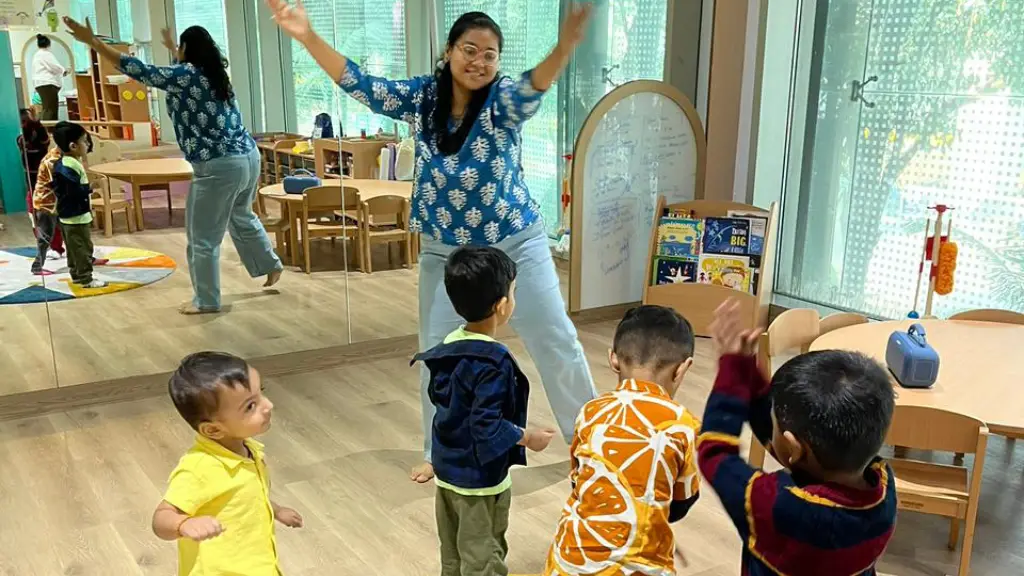
  • Our Playgroup & Toddler Engagement programs focus on:
  • Choice-based play to build autonomy
  • Reggio-inspired sensory and open-ended setups
  • HighScope Plan–Do–Review cycles
  • Emotional coaching (“I see you’re feeling…”)
  • Music, movement, art, stories that support whole-brain development
  • Predictable routines that help toddlers feel secure

How Parents Can Support

  • Offer choices (blue cup or yellow cup?)
  • Read daily
  • Label emotions
  • Encourage pretend play
  • Maintain simple, consistent routines

4. Preschool Stage (3 to 5 Years)

This is one of the most important and transformative developmental stages.

Key Milestones

  • Conversational language
  • Stronger social skills and friendships
  • Understanding simple rules
  • Creative storytelling
  • Recognising letters, numbers, shapes
  • Imaginative play and role-play
  • Increased independence and emotional regulation

Toddles Toodles Approach (Nursery & KG1)

Our curriculum blends:

  • IB PYP Units of Inquiry (“How We Express Ourselves”, “Who We Are”, etc.)
  • Reggio Emilia environments that spark curiosity
  • Waldorf rhythms and creative arts
  • Jolly Phonics for early literacy
  • Hands-on numeracy through play
  • Sensory science, nature exploration, movement
  • Mindfulness, kindness, empathy-building circles

Children learn through meaningful experiences—not rote work.

  • How Parents Can Support
  • Read aloud daily
  • Encourage curiosity (“Why do you think…?”)
  • Provide opportunities for independence
  • Support imaginative play
  • Spend time outdoors

5. School-Age Stage (5 to 12 Years)

While Toddles Toodles focuses on ages 0–5, this stage provides important context.

Key Milestones

  • Fluent reading, writing, numeracy
  • Stronger reasoning and problem-solving
  • Real friendships and social understanding
  • More independence and responsibility
  • Interest in hobbies and projects

How Toddles Toodles Prepares Children for This Stage

  • Our KG1 program builds the foundation for:
    Independence
  • Emotional well-being
  • Strong literacy and numeracy exposure
  • Social skills and empathy
  • Curiosity-driven thinking and confidence

These set the stage for a smooth transition into formal schooling.

The Five Main Areas of Child Development

Development grows across five interconnected domains:

  1. Physical Development — motor skills, coordination
  2. Cognitive Development — thinking, reasoning, problem-solving
  3. Language Development — vocabulary, communication, listening
  4. Social Development — interaction, teamwork, cooperation
  5. Emotional Development — feelings, confidence, self-regulation

At Toddles Toodles, our curriculum intentionally blends all five.

Key Developments in Early Childhood

  • Motor skills
  • Communication growth
  • Emotional recognition
  • Social awareness
  • Early literacy and numeracy
  • Creative thinking

These create the foundation for school readiness and future learning.

What Is the Best Age for a Child to Start Preschool?

Most children are ready between 2.5 and 3.5 years, depending on:

  • Ability to communicate basic needs
  • Comfort with short separations
  • Curiosity and independence
  • Emotional readiness

Toddles Toodles ensures a gentle, child-led transition during admissions.

FAQs About Child Development

In what development stage is the preschool child?

Ages 3–5 fall under early childhood.

School-age development (5–12 years).

Communication, curiosity, emotional expression, and active play.

Read, talk, play, follow routines, and give emotional support.

Yes—preschool builds social, emotional, and early academic skills.

Basic communication, early literacy exposure, simple instructions, and social comfort.

Our blended approach uses the strengths of each method, tailored to the child.

Look for curiosity, independence, communication ability, and comfort with separation.

Conclusion: Every Stage Matters in Your Child’s Growth Journey

Every stage of development is a building block. At Toddles Toodles, we’re committed to providing a nurturing, curiosity-driven, play-based environment where children feel safe, confident, and excited to learn.

Your involvement, love, and presence are the greatest contributors to your child’s growth—and we’re honoured to partner with you in this journey.